Number bonds worksheets
Two parts make a whole.
Examples temporarily replace the input and settings. You can restore your previous work.
Pro keeps the settings you use every week and puts them one click away. See Pro
Free PDFs end with a small “Made with nouplo.com” line Remove limits with Pro
Save to PinterestYour files stay on your device
This tool runs entirely in your browser. Nothing is uploaded, nothing is stored, and you can even turn off your internet connection before you start.
Example
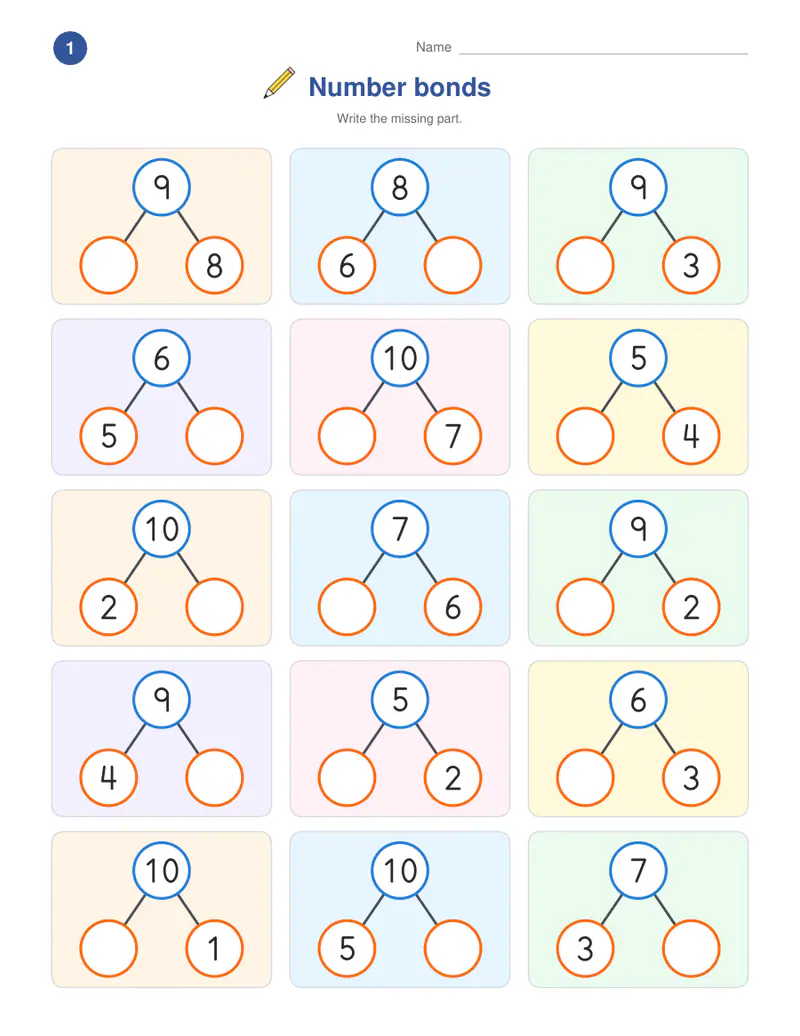
Example: one sheet of missing-part bonds to 10 for first grade, with answers
A first-grade teacher wants a quick check on number bonds to 10. Style “Number bonds”, Task “Find the missing part”, Numbers up to 10, In colour, 1 page, “Add the answers” on, worksheet number 1, US Letter.
- The sheet has 15 bonds, 3 across and 5 down. In each, the whole is given at the top and one of the two parts is missing.
- The wholes run from 5 to 10, and no split uses a 0: zeros only come up in bonds to 5.
- No split comes twice on the page: 9 is asked as 1 and 8, 6 and 3, 7 and 2, and 4 and 5.
- Page 2 is the answer key: the same 15 bonds with the missing parts in red.
| # | Whole | Parts shown | Answer |
|---|---|---|---|
| 1 | 9 | □ and 8 | 1 |
| 2 | 8 | 6 and □ | 2 |
| 3 | 9 | □ and 3 | 6 |
| 4 | 6 | 5 and □ | 1 |
| 5 | 10 | □ and 7 | 3 |
| 6 | 5 | □ and 4 | 1 |
| 7 | 10 | 2 and □ | 8 |
| 8 | 7 | □ and 6 | 1 |
| 9 | 9 | □ and 2 | 7 |
| 10 | 9 | 4 and □ | 5 |
| 11 | 5 | □ and 2 | 3 |
| 12 | 6 | □ and 3 | 3 |
| 13 | 10 | □ and 1 | 9 |
| 14 | 10 | 5 and □ | 5 |
| 15 | 7 | 3 and □ | 4 |
number-bonds.pdf: one worksheet with 15 blanks and its answer page. For a fresh sheet next week, change the worksheet number; once bonds to 10 are solid, move on to 20 or to “Make ten to add”.
How it works
- Choose the style — bonds, cherries or houses — and the task.
- Pick numbers up to 5, 10 or 20 and how many pages.
- Print; the answer pages come after all the sheets, in the same order.
Frequently asked questions
- What are number bonds?
- A whole and the two parts it splits into — 7 is 3 and 4, or 5 and 2. Knowing them by heart makes adding and subtracting fast.
- What is the make-ten task?
- To add 8 + 5, split the 5 into 2 and 3: 8 + 2 makes 10, and 10 + 3 is 13. The worksheet shows the split under the second number.
- Which style should I choose?
- Bonds are used in many English-speaking schools; cherries come from Japan’s first grade; number houses from German and French classrooms — all teach the same idea.
- Which grade is it for?
- Kindergarten and first grade: bonds to 5 and 10 first, then 20 and the make-ten strategy.
- How many problems are on a page?
- 15 bonds or cherries with numbers up to 10 or 20, 12 with numbers up to 5, 12 make-ten sums, and 8 number houses (12 when the task is to find the whole).
- Will I get the same worksheet again?
- Only with the same settings and worksheet number, which is handy for a second copy. Change the number for new problems; adding pages keeps the first pages as they were and adds new ones after them.
- Is anything uploaded?
- No. The pages are made in your browser.