Japanese covering letter (添え状)
Posting a résumé, an invoice or papers in Japan? This is the page expected on top.
Examples temporarily replace the input and settings. You can restore your previous work.
Enclosed
Pro keeps the settings you use every week and puts them one click away. See Pro
Your files stay on your device
This tool runs entirely in your browser. Nothing is uploaded, nothing is stored, and you can even turn off your internet connection before you start.
Example
Example: a freelance translator in Osaka posting her November invoice to a client
Anna Muster, a freelance translator living in Osaka, posts her November invoice and a work report to the accounts department of a client company (names and address made up). What you are sending: An invoice; after the last line: 御中, because the letter goes to a department, not a person.
- She leaves the subject and the letter empty, so the usual wording for an invoice is printed, and types her own two enclosures, which replace the default ・請求書 1通.
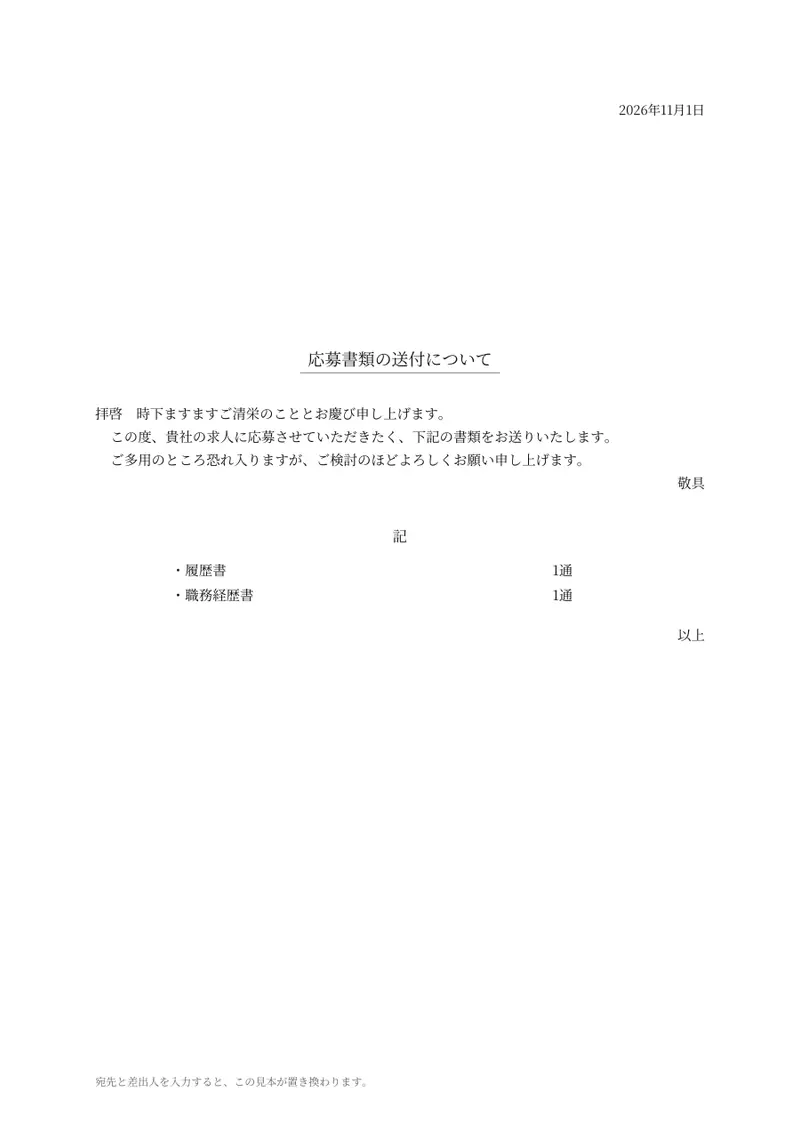
- For a job application she would choose Application documents instead: the subject becomes 応募書類の送付について, the list 履歴書 1通 and 職務経歴書 1通, and the last line 採用ご担当者 with 様.
| What she types or chooses | What the letter shows |
|---|---|
| Date: 2026-11-30 | 2026年11月30日, top right |
| To: 株式会社サンプル商事 / 経理部, one per line, with 御中 | 株式会社サンプル商事, and under it 経理部 御中: the honorific follows the last line only |
| From: 〒000-0000 / 大阪府大阪市北区見本町1-2-3 / Anna Muster(アンナ・ムスター) / 090-0000-0000 / anna@example.com | the five lines under the recipient, on the right |
| Subject: left empty | 請求書送付のご案内 (sending you our invoice), in the middle |
| The letter: left empty | 拝啓 時下ますますご清栄のこととお慶び申し上げます。, thanks for the custom, a request to check the enclosed invoice, then 敬具 |
| Enclosed: 請求書(2026年11月分) 1通; 作業報告書 1部 | 記, then ・請求書(2026年11月分) 1通 and ・作業報告書 1部, then 以上 on the right |
One A4 page, 送付状.pdf, with no footer of ours. She only typed names, addresses and the two enclosures; the greeting, the subject and the 記 … 以上 list were filled in in the form a Japanese office expects.
How it works
- Choose what you are sending: the wording and the list of enclosures are filled in for it.
- Type who it goes to, and choose 様 for a person or 御中 for a company.
- Type your own address and name.
- Change any line you want, then download the PDF and put it on top of the documents.
Frequently asked questions
- Is a covering letter really expected?
- For anything posted to a company in Japan, yes — documents arriving with no letter read as brusque. It is one page, and it says who sent what and why.
- Why is there no seasonal greeting?
- The opening used here (拝啓 時下ますますご清栄…) is the all-season one, which is correct in any month and is what most business letters use.
- What are 記 and 以上?
- The list of enclosures opens with 記 in the middle of the page and closes with 以上 on the right. It is the standard way of listing in a Japanese letter.
- 様 or 御中 — which one?
- 御中 when the last line of the address is a company or a department (経理部 御中), 様 when it is a person or 採用ご担当者 (採用ご担当者 様). Never both: put the department on one line and the person on the last, with 様.
- Can I write the letter in English?
- Every line can be rewritten, and English prints fine. But the date (2026年11月30日), the 記 … 以上 list and the honorific stay Japanese, so the result is a Japanese letter with English text in it. For a Japanese company, keep the Japanese wording and write your name in both forms, as in Anna Muster(アンナ・ムスター).
- Does the date use the Japanese era?
- No. The date is printed with the Western year in Japanese form: 2026-11-30 becomes 2026年11月30日. Leave the date empty for today’s date.
- Is anything uploaded?
- No, and the letter never carries the free plan’s footer.