French sworn statement (attestation sur l’honneur)
The paper French offices ask for, in French, ready to sign.
Examples temporarily replace the input and settings. You can restore your previous work.
Pro keeps the settings you use every week and puts them one click away. See Pro
Your files stay on your device
This tool runs entirely in your browser. Nothing is uploaded, nothing is stored, and you can even turn off your internet connection before you start.
Example
An attestation de domicile for the CAF, filled in and as it prints
Emily Sample, a British student in Lyon, applies for housing aid and the CAF asks for a sworn statement of address. Chosen: “Of address (domicile)”; born 14 March 2004 in Leeds; living at 12 rue de l’Exemple, 69007 Lyon since 1 September 2026; addressed to CAF du Rhône; signed in Lyon on 5 October 2026.
| Part of the page | What it says |
|---|---|
| Title | ATTESTATION SUR L'HONNEUR DE DOMICILE, with a small English gloss under it on this page |
| Addressed to | À l'attention de : CAF du Rhône |
| Who you are | Je soussigné(e) Emily Sample, né(e) le 14 mars 2004 à Leeds (Royaume-Uni), demeurant 12 rue de l’Exemple, 69007 Lyon, |
| What you declare | atteste sur l'honneur résider à l'adresse ci-dessus depuis le 1er septembre 2026. |
| Closing | Fait pour servir et valoir ce que de droit. Fait à Lyon, le 5 octobre 2026. |
| Foot of the page | The article 441-7 warning: up to a year in prison and a €15,000 fine for a false statement. |
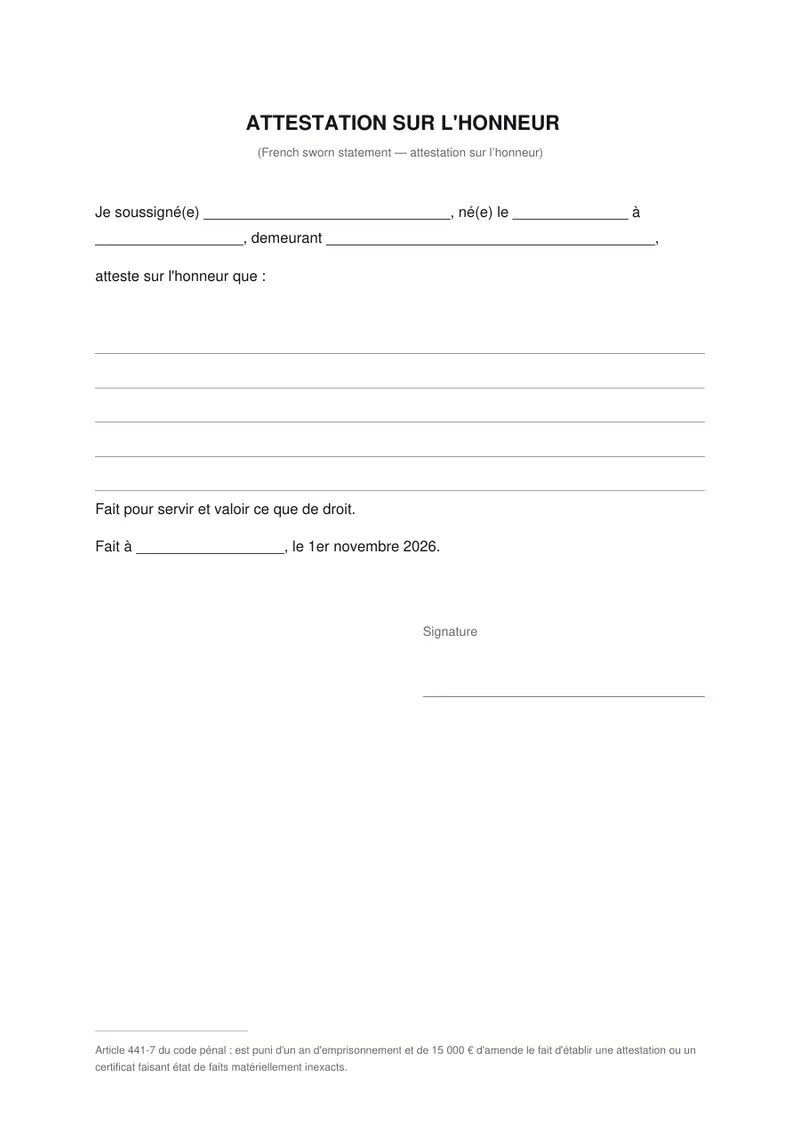
One page with a signature space and Emily Sample’s name under it. The dates are written the French way (1er septembre 2026) whatever the date boxes show. Print it, then date and sign by hand; many offices also want a copy of your ID.
How it works
- Choose the kind of statement, or free text.
- Enter your name, date and place of birth and address; add who it is for if you were told (CAF, mairie, bank).
- Write what you declare, in French, or complete the template.
- Download, print, date and sign by hand.
Frequently asked questions
- What is an attestation sur l’honneur?
- A written statement in which you declare something to be true on your own responsibility. French offices — the CAF, préfectures, banks, universities — ask for one in place of, or alongside, documents.
- Which statements are ready-made?
- Five, besides free text: of address (domicile), of living together (vie commune, with two signatures), of being single (célibat), of no conviction (non-condamnation, with your parents’ names) and of a lost document (perte, with the date of the loss).
- Does it have to be in French?
- Yes: it is handed in to a French office, so the paper is in French. This page’s form is in English; anything you type into the free-text box should be in French.
- Does it need a signature?
- Yes, by hand, with the date. Many offices also ask for a copy of your ID to compare the signature.
- What if it is false?
- Article 441-7 of the French penal code punishes a statement of facts known to be untrue with up to a year in prison and a €15,000 fine. The paper says so at the foot.
- Is this legal advice?
- No. It is a form. If in doubt about what you may declare, ask the office that wants it or a lawyer.
- Is what I type uploaded?
- No. The PDF is made in your browser and nothing you type leaves your device. Nothing of ours is printed on the paper.