Calcudoku puzzles
Sudoku with sums: every row and column once, every cage its target.
Examples temporarily replace the input and settings. You can restore your previous work.
Pro keeps the settings you use every week and puts them one click away. See Pro
Free PDFs end with a small “Made with nouplo.com” line Remove limits with Pro
Save to PinterestYour files stay on your device
This tool runs entirely in your browser. Nothing is uploaded, nothing is stored, and you can even turn off your internet connection before you start.
Example
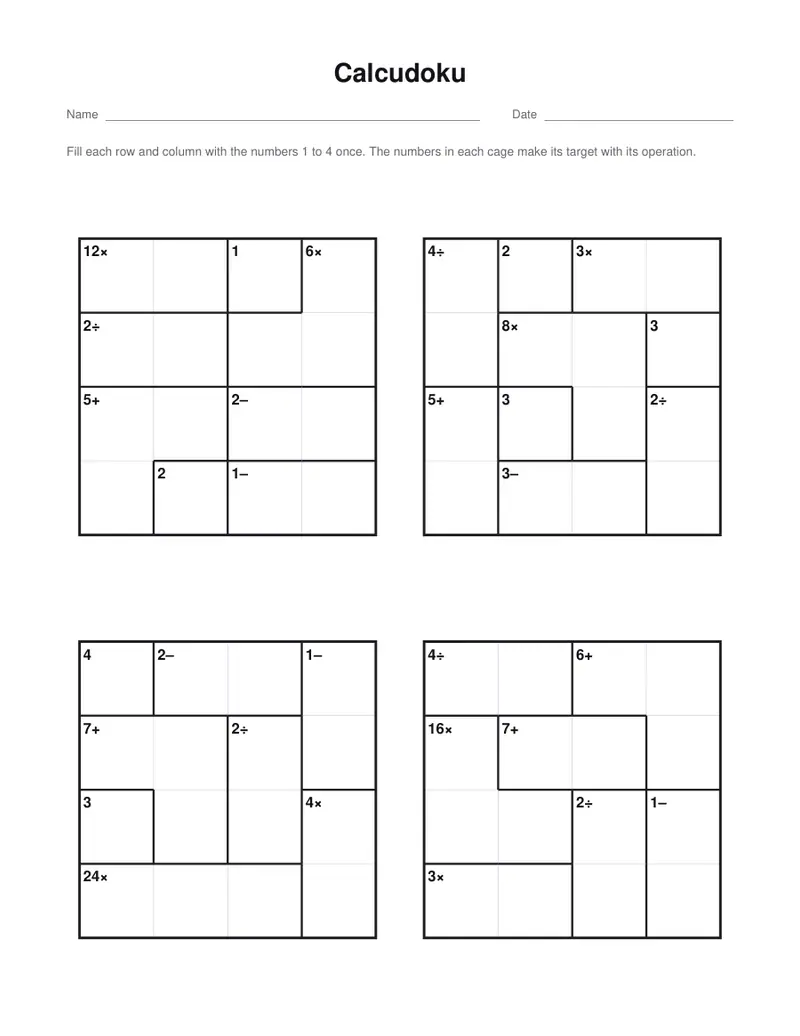
Four 4 × 4 calcudoku puzzles with all four operations, and how the first one opens up
A fifth-grade teacher wants a warm-up for the math centre. She keeps the page’s settings: Calcudoku, Grid 4 × 4, Operations “All four”, 4 puzzles on the page, answer page on, sheet number 1, US Letter. The first puzzle (columns A–D, rows 1–4) has the cages 12× in A1-B1, 1 in C1, 6× in D1-C2-D2, 2÷ in A2-B2, 5+ in A3-B3-A4, 2– in C3-D3, 2 in B4 and 1– in C4-D4.
- 12× in two squares can only be 3 × 4, so A1 and B1 are 3 and 4. Row 1 then needs 1 and 2: C1 is given as 1, so D1 = 2.
- The 6× cage with D1 = 2 needs C2 × D2 = 3, so 1 and 3; column C already has its 1, so C2 = 3 and D2 = 1.
- 2÷ in A2-B2 is 1 and 2 or 2 and 4; row 2 has 1 and 3, so 2 and 4. B4 = 2 rules out B2 = 2: B2 = 4, A2 = 2, so B1 = 3 and A1 = 4.
- 2– in C3-D3 can only be 2 and 4 (D3 cannot be 2), so C3 = 2, D3 = 4. The rest follows: C4 = 4, D4 = 3, A4 = 1, A3 = 3, B3 = 1, and 3 + 1 + 1 makes the 5+.
| A | B | C | D | |
|---|---|---|---|---|
| 1 | 4 | 3 | 1 | 2 |
| 2 | 2 | 4 | 3 | 1 |
| 3 | 3 | 1 | 2 | 4 |
| 4 | 1 | 2 | 4 | 3 |
calcudoku.pdf, two Letter pages: four puzzles with the rule under the title and Name and Date lines, then “Calcudoku — Answers” with the grids filled in. The other three bring a 4÷ cage, a 24× and a 16×. Sheet number 2 gives four new puzzles for next week.
How it works
- Choose the grid: 4 × 4 for beginners, 6 × 6 for a longer puzzle.
- Choose the operations: addition only, add and subtract, or all four.
- Choose how many puzzles go on the page.
- Download the PDF; the answers are on the second page.
Frequently asked questions
- How is calcudoku played?
- Each row and column holds the numbers 1 to the size of the grid once. The bold cages each show a target and an operation: 7+ means the numbers in it add to 7, 2÷ that one is twice the other. A single-square cage gives its number.
- Does each puzzle have only one answer?
- Yes. Every puzzle is solved by the generator before it is printed, and one with a second answer is thrown away and cut again.
- Where can subtraction and division appear?
- Only in two-square cages, as usual: the larger number minus or divided by the smaller. Larger cages add or multiply.
- How do I get different puzzles?
- Change the sheet number. The same settings and the same number always give the same puzzles, so a sheet can be printed again later, or a class can share one; number 2, 3 and on give new ones. Changing the grid, the operations or the number of puzzles also changes them.
- Which other puzzles can it make?
- Kakuro (a crossword of sums, 6 × 6 or 7 × 7), futoshiki (greater-than signs) and skyscrapers, 4 × 4 to 7 × 7 in three levels, and the binary puzzle of 0s and 1s, 6 × 6 to 12 × 12. Up to six go on a page; 7 × 7 grids and 10 × 10 binary puzzles four, 12 × 12 binary and hard kakuro two.
- Is anything uploaded?
- No. The sheet is made in your browser. On the free plan a small line with our name is printed at the foot of the last page.