Binary puzzles
Zeros and ones, three simple rules, one answer.
Examples temporarily replace the input and settings. You can restore your previous work.
Pro keeps the settings you use every week and puts them one click away. See Pro
Your files stay on your device
This tool runs entirely in your browser. Nothing is uploaded, nothing is stored, and you can even turn off your internet connection before you start.
Example
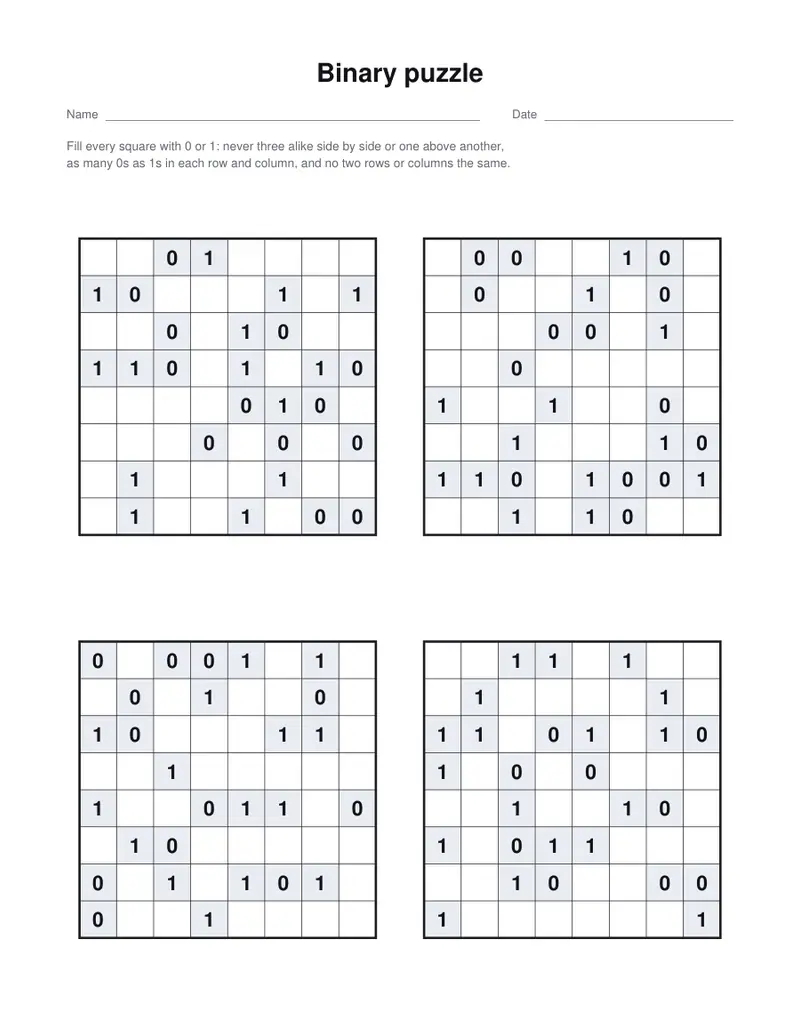
Example: puzzle 1 of the 6 × 6 easy sheet, and its first five moves
Settings: Grid 6 × 6, Level Easy, Puzzles on the page 6, Add an answer page, Sheet number 1, US Letter. Puzzle 1 gives 15 of its 36 squares, like the other five on the sheet. Below, rows are numbered 1 to 6 from the top and columns A to F from the left; · is an empty square.
- Row 1: E1 lies between two 1s (D1 and F1), so it is 0.
- Column A: A4 lies between two 0s (A3 and A5), so it is 1.
- Column F: F3 and F4 are a pair of 0s, so the squares either side of them, F2 and F5, are 1.
- Column F now has three 1s (F1, F2, F5), half of its six squares, so F6 is 0.
- Column D already has its three 1s (D1, D4, D6), so D3 and D5 are 0.
| A | B | C | D | E | F | |
|---|---|---|---|---|---|---|
| 1 | · | 0 | · | 1 | · | 1 |
| 2 | 1 | 0 | · | 0 | · | · |
| 3 | 0 | · | 1 | · | · | 0 |
| 4 | · | · | 0 | 1 | · | 0 |
| 5 | 0 | · | · | · | 0 | · |
| 6 | · | · | · | 1 | · | · |
binary-puzzle.pdf, 2 pages: the six puzzles and their answers. Every move above uses one of the three simple rules, which is all an easy puzzle needs. The same settings and sheet number always print these puzzles; Sheet number 2 gives six new ones.
How it works
- Choose the grid — 6 × 6 to learn, 12 × 12 for a long puzzle — and the level.
- Choose how many puzzles go on the page, and whether to add the answers.
- Download the PDF; the given numbers are shaded, the answers follow on their own page.
Frequently asked questions
- What are the rules?
- Fill every square with 0 or 1. No more than two of the same side by side or one above another; each row and column has as many 0s as 1s; and no two rows, or two columns, are the same.
- How do I start?
- Look for pairs: 1 1 must have a 0 on each side. Then gaps: 0 □ 0 must be 1 in the middle. When a row has all its 1s, the rest are 0s.
- What makes the hard ones hard?
- Easy and medium puzzles come out with those three moves alone. Hard ones need you to weigh a whole row — what would happen if a square were 0 — and the rule that no two lines are alike.
- Does each puzzle have only one answer?
- Yes. Every puzzle is solved before it is printed and has exactly one answer.
- Why do I get the same puzzles again?
- Because the sheet number chooses them: the same grid, level, count and number always print the same puzzles, so a class can be handed the same sheet twice or check it against the answers later. Change the sheet number for a new set.
- How many fit on a page?
- Up to six 6 × 6 or 8 × 8 puzzles, four 10 × 10 and two 12 × 12, so the squares stay big enough to write a digit in. Fewer to a page prints each one larger.
- Is there a footer on it?
- Only on the free plan: a small line “Made with nouplo.com” at the foot of the last page. With Pro there is none. Either way the sheet is made in your browser.