Turkish incident record (tutanak)
What happened, where and when — and who saw it — in the Turkish form.
Examples temporarily replace the input and settings. You can restore your previous work.
Pro keeps the settings you use every week and puts them one click away. See Pro
Your files stay on your device
This tool runs entirely in your browser. Nothing is uploaded, nothing is stored, and you can even turn off your internet connection before you start.
Example
Example: a tutanak for a water leak from the flat upstairs, in Istanbul
A British tenant in Kadıköy finds water coming through her bathroom ceiling on 14 October 2026. With the building manager and the owner of the flat upstairs she writes a record for her landlord. Title “Su sızıntısı tespit tutanağı”, date 14 October 2026, time 08:30; place, subject and what was seen in Turkish.
- The title is printed in capitals the Turkish way, with the dotless I and the dotted İ: SU SIZINTISI TESPİT TUTANAĞI.
- The three lines of what was seen become three paragraphs: the wet patch on the ceiling of flat 4, the leaking joint under the basin of flat 6 and its valve turned off, the photos taken.
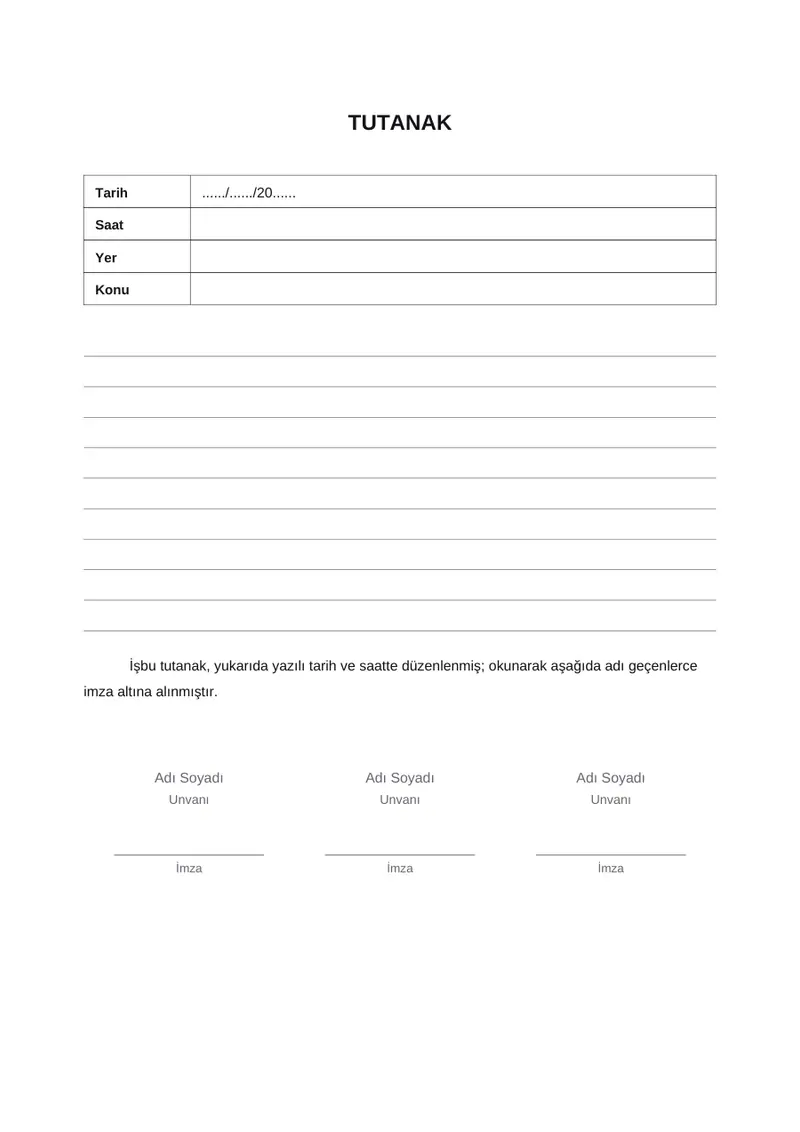
- Then the closing sentence that makes it a record: İşbu tutanak, yukarıda yazılı tarih ve saatte düzenlenmiş; okunarak aşağıda adı geçenlerce imza altına alınmıştır.
| In the form | Typed | On the paper |
|---|---|---|
| Title | Su sızıntısı tespit tutanağı | SU SIZINTISI TESPİT TUTANAĞI, centred |
| Date | 14 October 2026 | Tarih: 14.10.2026 |
| Time | 08:30 | Saat: 08:30 |
| Place | Örnek Apartmanı, Daire 4, Kadıköy / İstanbul | Yer: the same |
| Subject | Üst kattaki daireden gelen su sızıntısı | Konu: the same |
| Who signs, line 1 | Emily Sample | Daire 4 kiracısı | name in bold, title under it, a line marked İmza |
| Who signs, line 2 | Mehmet Örnek | Apartman yöneticisi | the second box in the same row |
| Who signs, line 3 | Zeynep Deneme | Daire 6 maliki | the third box in the same row |
One A4 page with the ruled block of date, time, place and subject, the account, the closing sentence and three signature boxes side by side, ready to print, read out and sign on the spot. Nothing of ours is printed on it.
How it works
- Write a title such as “Olay tespit tutanağı”, or leave it empty for TUTANAK.
- Enter the date, time, place and subject.
- Write what was seen and what happened, one paragraph per line.
- List the signers one per line as “Name | Title”, then download the PDF and have everyone sign.
Frequently asked questions
- What is a tutanak for?
- It is the record of an event written and signed by the people who were there, at the time or straight after. In a later dispute — an accident at work, damage, a disciplinary matter — it is one of the strongest records of what happened, and its weight is the signatures.
- How should it be written?
- Plainly and without comment: who, when, where, what was done and what was seen. The closing sentence says the record was read and signed by those named.
- Is this legal advice?
- No. Where it may lead to dismissal or compensation, talk to a lawyer.
- Do I have to write it in Turkish?
- The printed labels and the closing sentence are always in Turkish — Tarih, Saat, Yer, Konu, İşbu tutanak… — because the record is used in Turkey. Write what was seen in Turkish too, so that everyone who signs can read what they sign. Turkish letters such as ğ, ş, ı and İ print correctly.
- How many people can sign?
- The signers go three to a row, each with a name, a title and a line marked İmza. With a short account, up to nine fit on the first page; any more continue on a second page. Leave the list empty and three blank boxes are printed, to fill in by hand.
- Is anything uploaded?
- No. The PDF is made in your browser.