Sequencing worksheets
First, then, next, last.
Examples temporarily replace the input and settings. You can restore your previous work.
Pro keeps the settings you use every week and puts them one click away. See Pro
Free PDFs end with a small “Made with nouplo.com” line Remove limits with Pro
Save to PinterestYour files stay on your device
This tool runs entirely in your browser. Nothing is uploaded, nothing is stored, and you can even turn off your internet connection before you start.
Example
Second grade writing: two “Tell the story” pages, four pictures each, US Letter
A second-grade teacher wants a retelling task for the writing center. Settings: 4 pictures per story, Task “Write the story”, In colour, 2 pages, worksheet number 1, US Letter. The file is sequencing-cards.pdf, two pages.
- Each page has one story under the heading “Tell the story”, with Name at the top. Its four pictures are already in order, two by two, 70 mm (about 2¾ in) across, numbered 1 to 4.
- Under each picture are three lines to write on, one sentence per picture; children link them with first, then, next and last.
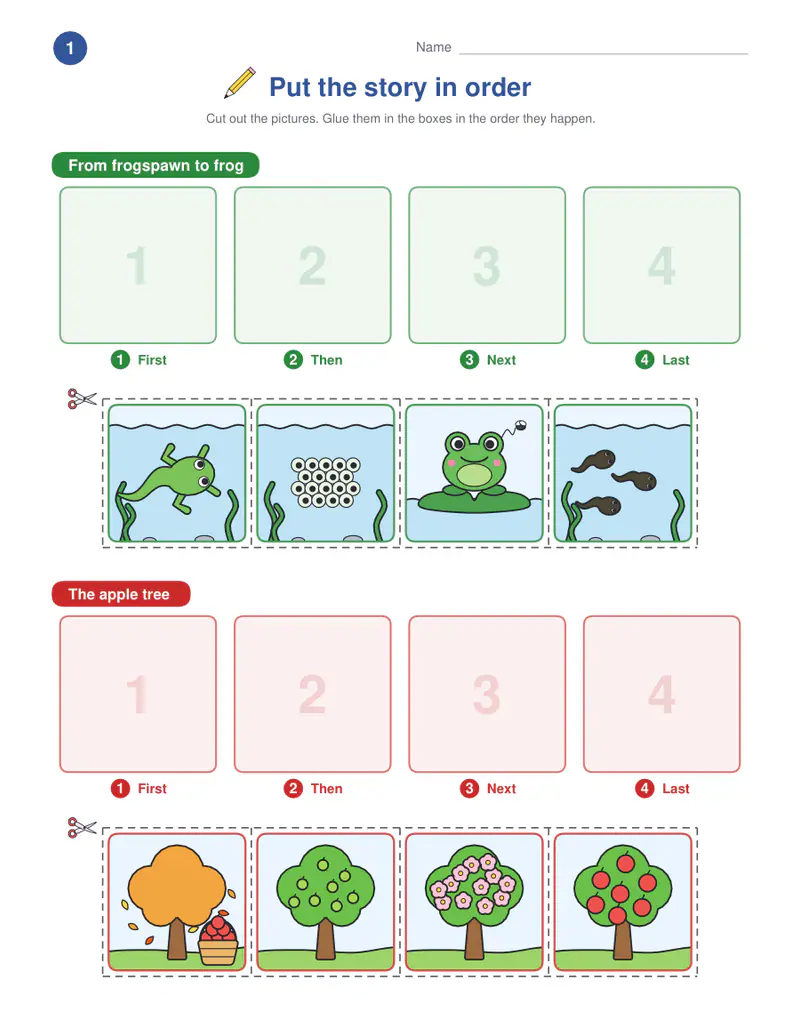
- Page 1, “From frogspawn to frog”: frogspawn, tiny tadpoles, a tadpole with four legs, the frog on the bank. Page 2, “The apple tree”: blossom, small green apples, red apples, autumn and a full basket.
- A writing page is its own answer, so “Add the answers” adds no pages. Switch the task to “Cut and glue in order” and worksheet 1 starts with the same two stories, two to a page.
| Page | Story | Pictures 1 to 4 |
|---|---|---|
| 1 | From frogspawn to frog | frogspawn · tiny tadpoles · tadpole with four legs · frog on the bank |
| 2 | The apple tree | blossom · small green apples · ripe red apples · autumn leaves, full basket |
Two Letter pages, no answer key needed: print one set per child. The same settings always give the same file; worksheet number 3 starts with “Building a snowman” for another week.
How it works
- Choose 3, 4 or 6 pictures per story and the task.
- Print; children look at each picture and talk about what happens.
- They cut and glue, number the pictures or write the story — the answers follow for cutting and numbering.
Frequently asked questions
- What do sequencing activities teach?
- Time order and cause and effect — what happens first and what follows — the base of retelling stories and of reading comprehension.
- Which stories are included?
- Everyday ones: a seed that grows into a flower, a caterpillar that becomes a butterfly, building a snowman, washing hands, making a sandwich and more.
- Which age is it for?
- Three pictures from about four years; six pictures and the writing task for first and second grade.
- How can I use them in class?
- As a warm-up for storytelling: children retell the story using first, then, next and last.
- Is there an answer key?
- For cut and glue and for numbering, yes: “Add the answers” adds one page per worksheet, with the pictures glued in order or the numbers written in red. The writing task already shows the pictures in order, so it gets none.
- How many stories fit on a page?
- Two with three pictures and one with six. With four pictures, two to cut out (each strip four across), but one to number or write about, laid out two by two and larger.
- Is anything uploaded?
- No. The pages are made in your browser.