Envelope templates
Cut, fold and glue an envelope in the size you need.
Examples temporarily replace the input and settings. You can restore your previous work.
Pro keeps the settings you use every week and puts them one click away. See Pro
Your files stay on your device
This tool runs entirely in your browser. Nothing is uploaded, nothing is stored, and you can even turn off your internet connection before you start.
Example
Example: two patterned A7 envelopes for 5 × 7 photo cards to mail
Two 5 × 7 in holiday photo cards are going in the mail to both sets of grandparents. Settings: Envelope size A7 — 5¼ × 7¼ in, Look Patterned, Envelopes 2, Design number 1, Paper US Letter.
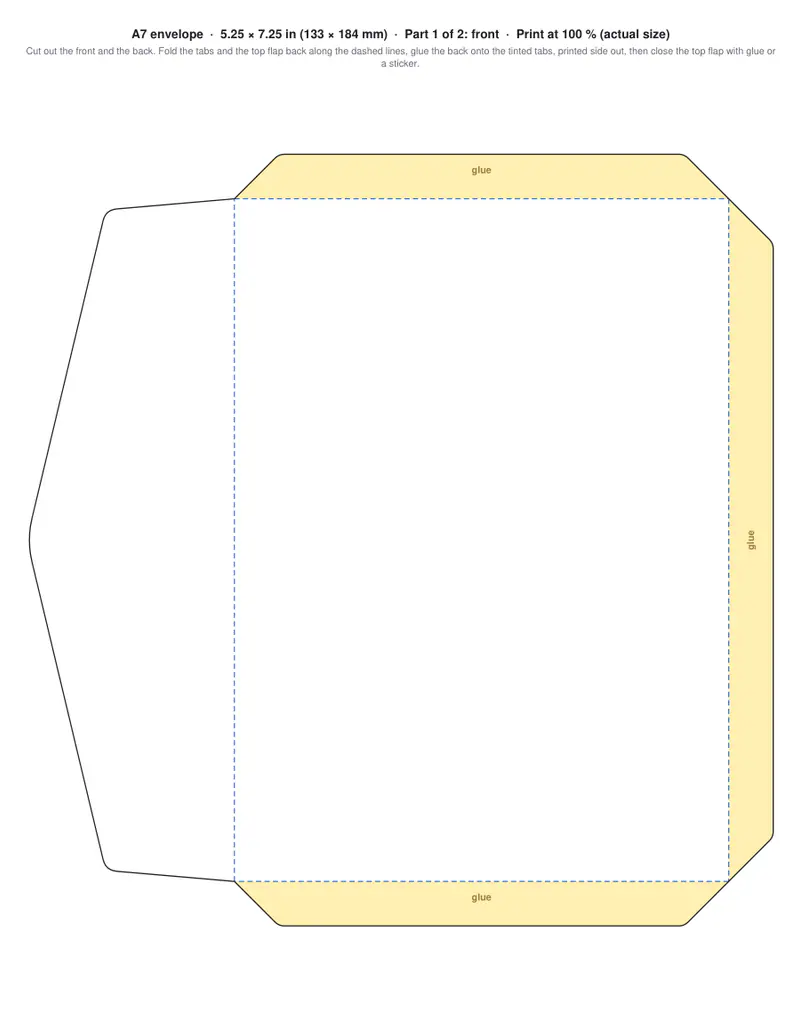
- An A7 envelope opens out wider than a Letter sheet, so each one prints in two parts: envelopes.pdf has 4 pages, the front with its tabs and flap, then the back, for each envelope.
- Each page is headed “A7 envelope · 5.25 × 7.25 in (133 × 184 mm) · Print at 100 % (actual size)”. Print at 100 % and cut out the front and the back along the solid lines.
- Fold the tabs and the top flap back along the dashed lines, glue the back onto the tinted tabs, printed side out, and close the flap with glue or a sticker.
- A 5 × 7 card has ¼ in to spare each way. Each envelope gets its own pattern, on the flaps; the front stays white for the address and stamp.
| Size | Finished | Fits | Letter pages per envelope | By mail in the US |
|---|---|---|---|---|
| A7 | 5¼ × 7¼ in | a 5 × 7 card | 2 | as a letter |
| #10 | 4⅛ × 9½ in | a Letter sheet folded in three | 2 | as a letter |
| C6 | 114 × 162 mm (4½ × 6⅜ in) | a Letter sheet folded in four | 1 | as a letter |
| DL | 110 × 220 mm | an A4 sheet folded in three | 2 | as a letter |
| Square | 15 × 15 cm (5.9 in) | a square card | 2 | extra postage: square envelopes cannot go through sorting machines |
| Small | 70 × 110 mm | a gift card, folded bills | 1 | too small to mail: hand it over |
envelopes.pdf: 4 Letter pages that make two A7 envelopes with different patterns. Plain printer paper works; 100–120 g/m² paper, about 27–32 lb bond, makes a sturdier envelope.
How it works
- Choose the envelope size — the card or letter you want to send decides it.
- Pick plain, patterned or outlines to colour, and how many envelopes.
- Print at 100 % (“actual size”), cut along the solid lines, fold the dashed lines and glue the flaps.
Frequently asked questions
- Which envelope size do I need?
- A7 (5¼ × 7¼ in) fits a 5 × 7 card, #10 a letter folded in three; in metric sizes C6 fits an A6 card or A4 folded in four and DL A4 folded in three. The small one holds a gift card or folded banknotes.
- Why must I print at 100 %?
- The template is drawn at the real size; “fit to page” shrinks it and the card won’t fit any more. Choose “actual size” or 100 % in the print dialog.
- Which paper works best?
- Plain printer paper is fine; for a sturdier envelope use 100–120 g/m² paper. Patterned designs print on the outside of the flaps, the front stays white for the address.
- Why are some envelopes in two parts?
- A whole A7, #10, DL or square envelope unfolds wider than a sheet of paper, so these print as a front with tabs and a back to glue onto them — still at true size. C6 and the small envelope print in one piece.
- Which envelope fits a card made from one Letter sheet?
- A greeting card folded in four from Letter is 4¼ × 5½ in: it fits the C6 envelope, 4½ × 6⅜ in, or the A7 with more room. Folded in half it is 5½ × 8½ in, larger than any envelope here.
- Can I mail the small envelope?
- No. At 70 × 110 mm it is smaller than the smallest size US mail accepts, 3½ × 5 in. It is meant for handing over a gift card or a few folded bills.
- Is anything uploaded?
- No. The template is drawn in your browser.
Related tools
▣ Gift box templates A small box for a small present — print, cut, fold. ✉ Printable greeting cards A folded card from one sheet of paper: drawing on the front, your words inside. ✉ Text tools Address Japanese postcards Type the address in Japanese; it comes out vertical, in the right places, as a Japanese reader expects. ⬠ Printable gift tags A tag for every present, names already on.