Paper airplane templates
Fold along the numbered lines — 1, 2, 3 — and fly.
Examples temporarily replace the input and settings. You can restore your previous work.
Pro keeps the settings you use every week and puts them one click away. See Pro
Free PDFs end with a small “Made with nouplo.com” line Remove limits with Pro
Save to PinterestYour files stay on your device
This tool runs entirely in your browser. Nothing is uploaded, nothing is stored, and you can even turn off your internet connection before you start.
Example
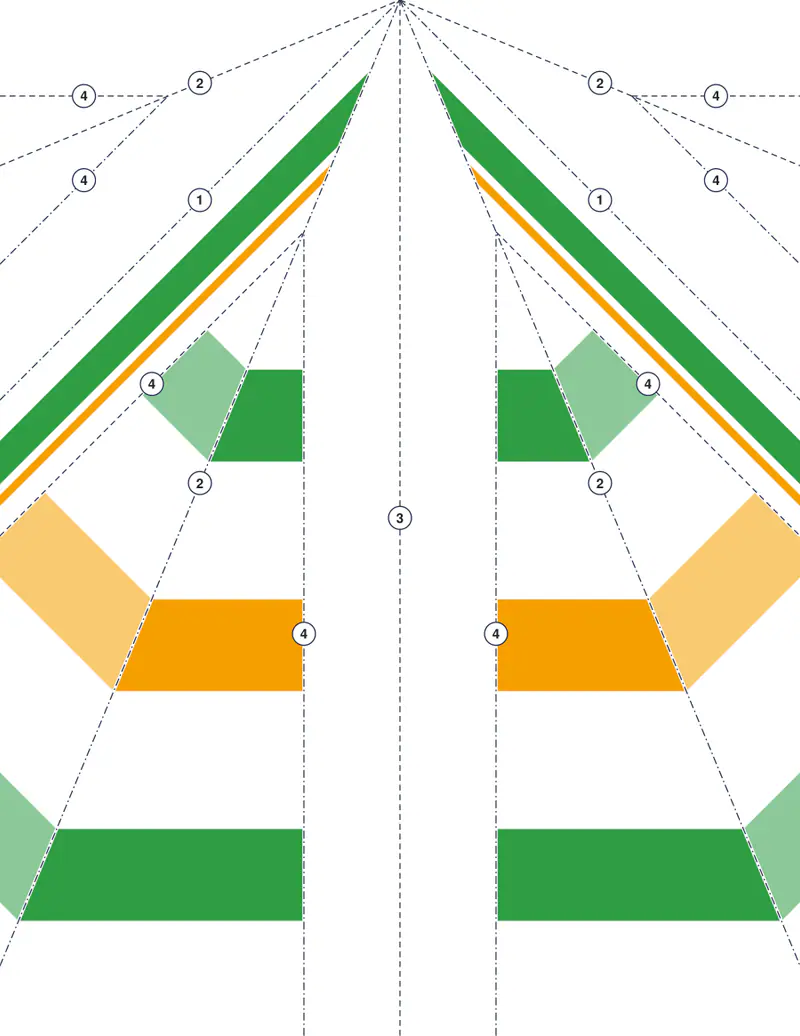
Example: the long-distance glider for a classroom distance contest, in six folds
A fourth-grade class holds a paper airplane distance contest in the gym. Settings: Plane “Long-distance glider”, Decoration “Stripes”, the page with the folding steps ticked, US Letter. paper-airplanes.pdf has 2 pages: the sheet to fold, its lines numbered 1 to 6, then the steps.
- Lay the sheet printed side up: the whole sheet becomes the plane, nothing to cut.
- Fold in number order and crease each fold with a fingernail. Folds 1 and 6 are valley folds (dashed lines), folds 2 to 5 mountain folds (dash-dot lines).
- Open the wings level, with a slight V seen from the front, and throw gently, slightly upwards.
| Fold | What the steps page says | Kind of fold |
|---|---|---|
| 1 | Fold the two top corners in to the centre line. | Valley |
| 2 | Fold the point down along the line. | Mountain |
| 3 | Fold the top corners in to the centre line, over the point. | Mountain |
| 4 | Fold the slanted edges in to the centre line. | Mountain |
| 5 | Fold the plane in half along the centre line. | Mountain |
| 6 | Fold each wing down along its line, one on each side. | Valley |
One plane per student: print the first page once for each. The folded-down point under the corners keeps the weight forward, which is what carries this glider farthest. For a contest between designs, “All five, one sheet each” gives 10 pages, each plane followed by its steps.
How it works
- Choose a plane — or all five — and a decoration.
- Print on plain paper (the whole sheet is the plane, nothing to cut).
- Fold along the lines in the order of their numbers: dashed lines fold towards you, dash-dot lines away.
Frequently asked questions
- Which plane flies farthest?
- The long-distance glider, with its folded-in nose that keeps the weight forward; the dart is fastest, the glider floats slowest. Try them all and have a contest.
- What do the two kinds of lines mean?
- A dashed line is a valley fold — fold the paper towards you so the line ends up inside the crease. A dash-dot line is a mountain fold — fold it away so the line stays on the outside.
- Why does my plane dive or stall?
- If it dives, bend the back edges of the wings up a little; if it climbs and stalls, bend them down. Make sure both wings are the same shape.
- What does “All five, one sheet each” print?
- Ten pages: each of the five planes (dart, glider, delta wing, long-distance glider, stunt plane) followed by its page of folding steps. Untick the steps page and it is five sheets, one plane each.
- What does the colour set number change?
- The decoration only: a new number gives other colours and moves the stars, spots and shapes. The plane, its fold lines and their numbers stay exactly the same, so a group can fold the same model in different colours.
- Which paper is best?
- Ordinary printer paper (80 g/m²). Thicker paper is harder to fold sharply; crease every fold with a fingernail.
- Is anything uploaded?
- No. The templates are drawn in your browser.