Japanese settlement agreement
A 示談書 in Japanese, clause by clause.
Examples temporarily replace the input and settings. You can restore your previous work.
Pro keeps the settings you use every week and puts them one click away. See Pro
Your files stay on your device
This tool runs entirely in your browser. Nothing is uploaded, nothing is stored, and you can even turn off your internet connection before you start.
Example
Example: a bicycle collision in Osaka settled for ¥350,000, with after-effects kept open
Mark (fictitious), a teacher in Osaka, knocked a pedestrian over with his bicycle on 3 October 2026; she hurt her wrist and missed two days’ work. They agree ¥350,000 for treatment and lost pay. The form: Traffic accident, A 山田花子, B マーク・テイラー, Settlement 350000, Pay by 2026-12-15, Date signed 2026-11-30, Japanese era, forgiveness ticked (off by default for traffic), after-effects left on.
- The sum is written in 大字 so it cannot be altered, with the figures beside it: 金参拾五萬円也(¥350,000).
- Dates come out in the Japanese era: the accident 令和8年10月3日, payment by 令和8年12月15日, signed 令和8年11月30日. Western gives 2026年 instead.
- For a traffic accident the sum is called 損害賠償金 (damages), and the after-effects clause comes just before the clean-slate clause.
- Place, time and what happened are typed in Japanese, e.g. 大阪市北区の歩道上, and print under 記 as typed.
| Article | Heading | What it says |
|---|---|---|
| 第1条 | 示談金 | B owes A ¥350,000 as damages for the accident |
| 第2条 | 支払方法 | paid by bank transfer to A’s account by 令和8年12月15日; B pays the transfer fee |
| 第3条 | 宥恕 | A forgives B and does not seek criminal punishment |
| 第4条 | 後遺障害 | after-effects that appear later will be discussed separately |
| 第5条 | 清算条項 | apart from this agreement, neither owes the other anything over the accident |
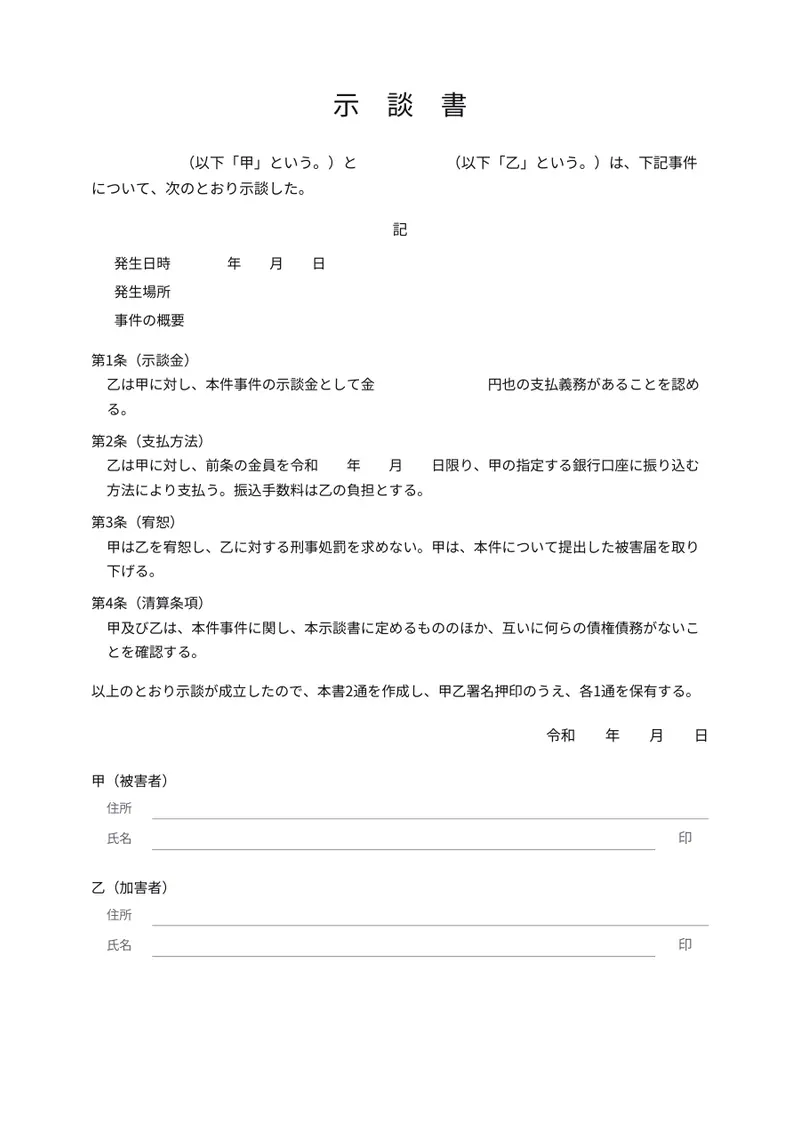
示談書.pdf, an A4 page in Japanese titled 示 談 書, with lines for both addresses and names and 印 for the seals. Print two copies; both of you sign and seal both and each keeps one, as its last sentence says. It is a template, not legal advice.
How it works
- Choose what happened and enter both parties.
- Enter the date, place and what happened.
- Enter the sum and the payment date.
- Download, print two copies and sign and seal both.
Frequently asked questions
- What is 宥恕?
- The victim’s statement that they forgive the other party and do not seek criminal punishment; prosecutors take it into account.
- Is this legal advice?
- No, it is a template.
- Why is the amount written 金参拾五萬円也?
- That is the sum in 大字, the formal numerals used on contracts and receipts because a stroke or two cannot turn one into another, as 一 can become 二 or 十. The figures follow in brackets, ¥350,000, and 也 closes the sum so nothing can be added after it.
- What does the after-effects clause do?
- It is offered for a traffic accident only. The clean-slate clause at the end says nothing more is owed over the accident; the after-effects clause keeps one door open, so that if the injury leaves 後遺障害 found later, the two of you discuss that damage separately.
- Can I fill it in in English?
- The clauses are fixed Japanese text. Type the place, the time, what happened and any other terms in Japanese, since they are printed into the Japanese document as typed; names can be in kanji, katakana or Latin letters.
- Is what I type uploaded?
- No. The PDF is made in your browser.