Japanese mourning card (喪中はがき)
Sent in November, before the New Year cards are written: the wording is set by custom, and it is written for you.
Examples temporarily replace the input and settings. You can restore your previous work.
Pro keeps the settings you use every week and puts them one click away. See Pro
Your files stay on your device
This tool runs entirely in your browser. Nothing is uploaded, nothing is stored, and you can even turn off your internet connection before you start.
Example
Example: a mourning card for a mother-in-law who died in June, sent from Yokohama
Emma Clarke, British, lives in Yokohama with her husband Kenji Sato (both fictitious). Kenji’s mother, Kazuko, died in June aged 87, so this year they send mourning cards instead of New Year cards. For her own friends and colleagues Emma chooses Mother-in-law (義母), types 佐藤 和子, age 87, month June, and three lines for the foot of the card. Date and message stay empty.
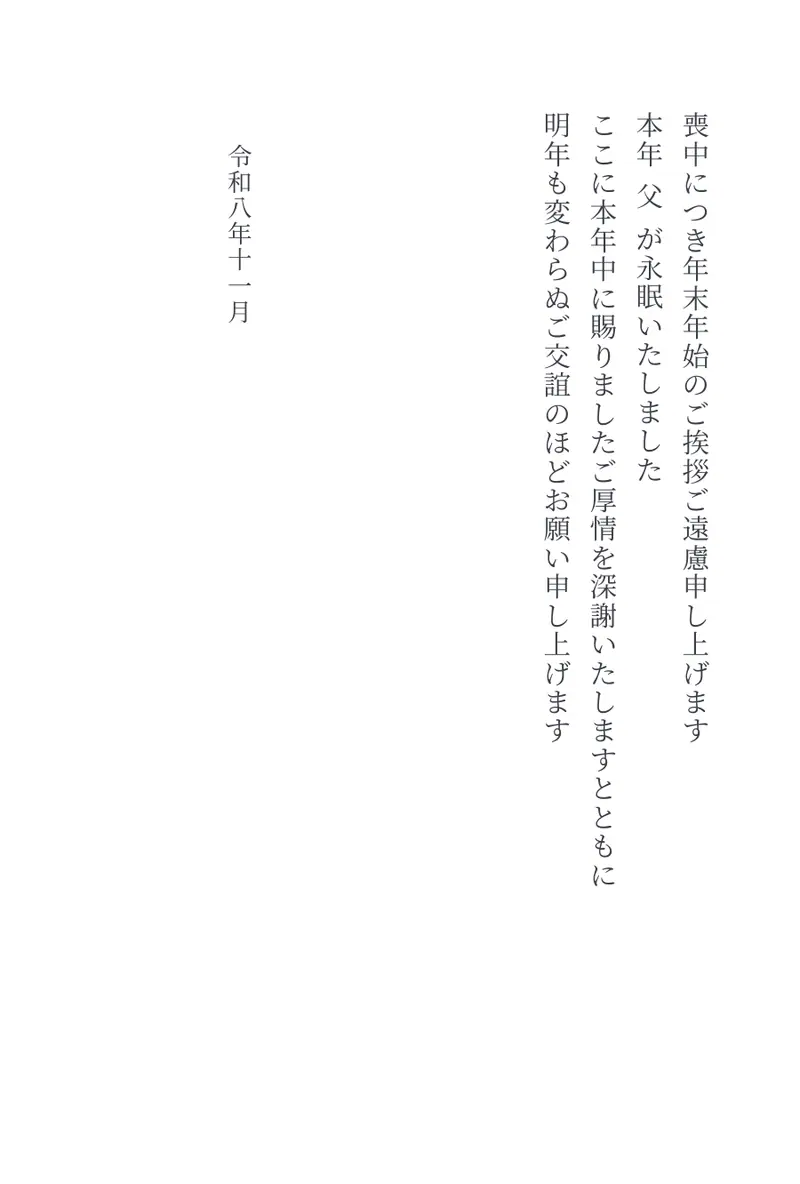
- The death line is built from the four fields: 本年六月 義母 佐藤 和子 が八十七歳にて永眠いたしました, “in June this year my mother-in-law Kazuko Sato passed away at 87”, with the numbers in kanji.
- Around it go the fixed sentences: New Year greetings are withheld because of mourning, thanks for the year’s kindness, and a request for the same friendship next year. No 拝啓, no punctuation.
- The empty date becomes 令和八年十一月, November of Reiwa 8 (2026): the month only, as these cards are dated.
- The sender lines are set vertically, so their numbers turn into kanji: 〒231-0001 becomes 〒二三一|〇〇〇一 and the house number 1-2-3 becomes 一|二|三.
- Kenji makes his cards for his own contacts the same way with Mother (母): his line reads 本年六月 母 佐藤 和子 が八十七歳にて永眠いたしました.
喪中はがき.pdf at 100 × 148 mm: four vertical lines read right to left, then the date and the three sender lines, and nothing of ours on it. Print it on the message side of the postcards and post them in November, before people write their New Year cards.
How it works
- Choose who died, and add their name, age and the month if you write them.
- Type your own address and name for the foot of the card.
- Change the wording if you want; leaving it empty gives the sentences custom expects.
- Download the PDF and print it on the message side of the postcard. The address side is printed by the addressing tool.
Frequently asked questions
- When is it sent?
- Through November and into the first days of December, so it arrives before the other person writes their New Year cards. After that, a 寒中見舞い in January is sent instead.
- Why is there no greeting or punctuation?
- A mourning card leaves out the seasonal opening (拝啓 and the like) and traditionally uses no full stops or commas. The wording here follows that.
- Do I have to say the age?
- No. Both the age and the month can be left out, and the sentence is written without them.
- Which relation do I choose when we send as a couple?
- Choose it as the sender sees it: your own mother is 母 (Mother), your spouse’s mother is 義母 (Mother-in-law). Spouses who send separate cards to their own contacts make one each, as in the example. For a single card from both names, pick the view of the one whose parent it was, or write the whole message yourself in the message box.
- How is the date written?
- As the month the card is written, in the Japanese era year and in kanji, without a day: left empty it reads 令和八年十一月, November of Reiwa 8, in 2026. If you send the cards in early December, type 令和八年十二月 in the date field instead.
- Is anything uploaded?
- No, and the card never carries the free plan’s footer.