Counting money worksheets
Add up the coins and bills, write the total.
Examples temporarily replace the input and settings. You can restore your previous work.
Pro keeps the settings you use every week and puts them one click away. See Pro
Free PDFs end with a small “Made with nouplo.com” line Remove limits with Pro
Save to PinterestYour files stay on your device
This tool runs entirely in your browser. Nothing is uploaded, nothing is stored, and you can even turn off your internet connection before you start.
Example
Example: a first coin-counting sheet, 8 sums under a dollar, with answers
For a class starting on coins. Settings: Sheet Count the money, Level Easy — coins under a dollar, Currency US dollars, 8 questions, Black and white, answer page ticked, sheet number 1, Name and date at the top, US Letter. counting-money.pdf has 2 pages: the sheet, then the answers in blue.
- Each row shows 2 to 5 coins, largest first, each with its value on it (1¢, 5¢, 10¢, 25¢), so children add values rather than recognise pictures.
- The child writes the total on the line after the = sign; the answer page repeats the rows with the totals filled in.
- The same sheet number always gives the same sheet; 2, 3, 4 and on give new sums at the same level.
| No. | Coins on the sheet | Answer |
|---|---|---|
| 1 | 25¢, 10¢ | 35¢ |
| 2 | 25¢, 25¢, 1¢ | 51¢ |
| 3 | 25¢, 5¢, 1¢ | 31¢ |
| 4 | 25¢, 1¢, 1¢ | 27¢ |
| 5 | 25¢, 5¢ | 30¢ |
| 6 | 25¢, 10¢, 5¢, 1¢, 1¢ | 42¢ |
| 7 | 10¢, 10¢, 5¢, 5¢, 1¢ | 31¢ |
| 8 | 10¢, 10¢ | 20¢ |
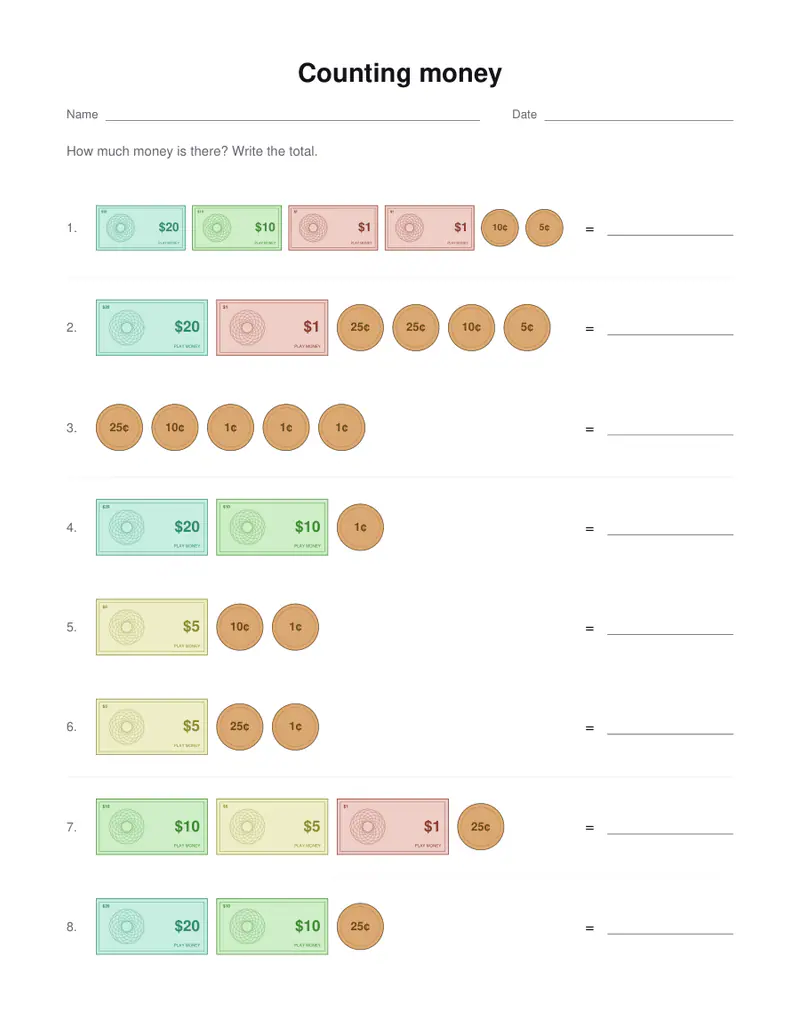
Totals under a dollar are written in cents, as they are taught: 51¢, not $0.51. Next step: Medium adds $1, $5, $10 and $20 bills (its sheet 1 opens with $20 + $10 + $1 + $1 + 10¢ + 5¢ = $32.15), and Work out the change at Easy pays for every item with $1.
How it works
- Choose the level: coins only, coins and small bills, or everything.
- Choose how many questions go on the page.
- Download the PDF; the totals are on the answer page.
- Switch to working out the change for the next step.
Frequently asked questions
- Which coins and bills are used?
- In dollars the 1¢, 5¢, 10¢ and 25¢ coins and the $1 to $100 bills: the easy level keeps to coins under a dollar, medium adds bills up to $20, hard uses everything.
- Do the coins look like real ones?
- No — they are the same simple play money as on our play-money page, with the value written on each, so children read the value rather than recognise a picture.
- Can I print it in other currencies?
- Yes: euros, pounds, reais, lira, yen and won are in the currency list.
- Which level fits which grade?
- Easy uses only pennies, nickels, dimes and quarters, 2 to 5 coins a row, for children learning what each coin is worth. Medium adds $1, $5, $10 and $20 bills with 3 to 6 pieces a row, the second-grade step of counting dollars and cents together. Hard uses every coin and bill up to $100, 4 to 7 pieces a row.
- How do I get a different sheet?
- Change the sheet number. The same settings and number always give the same questions, so a sheet can be printed again for a child who was absent, while 2, 3, 4 and on give new ones.
- What does the change sheet ask?
- Each row gives a price and the bill or coin it is paid with, and the child writes the change. At Easy every price is under a dollar, in steps of 5¢, and is paid with $1. At Medium prices run from $1 to $20 in steps of 5¢ and are paid with the smallest bill that covers them, now and then the next one up: $16.90 paid with $20, $3.10 back.
- Is anything uploaded?
- No. The sheet is made in your browser. On the free plan a small line with our name is printed at the foot of the last page.